

Ayutthaya Temple Historical Park: Complete Overview Guide (2026)
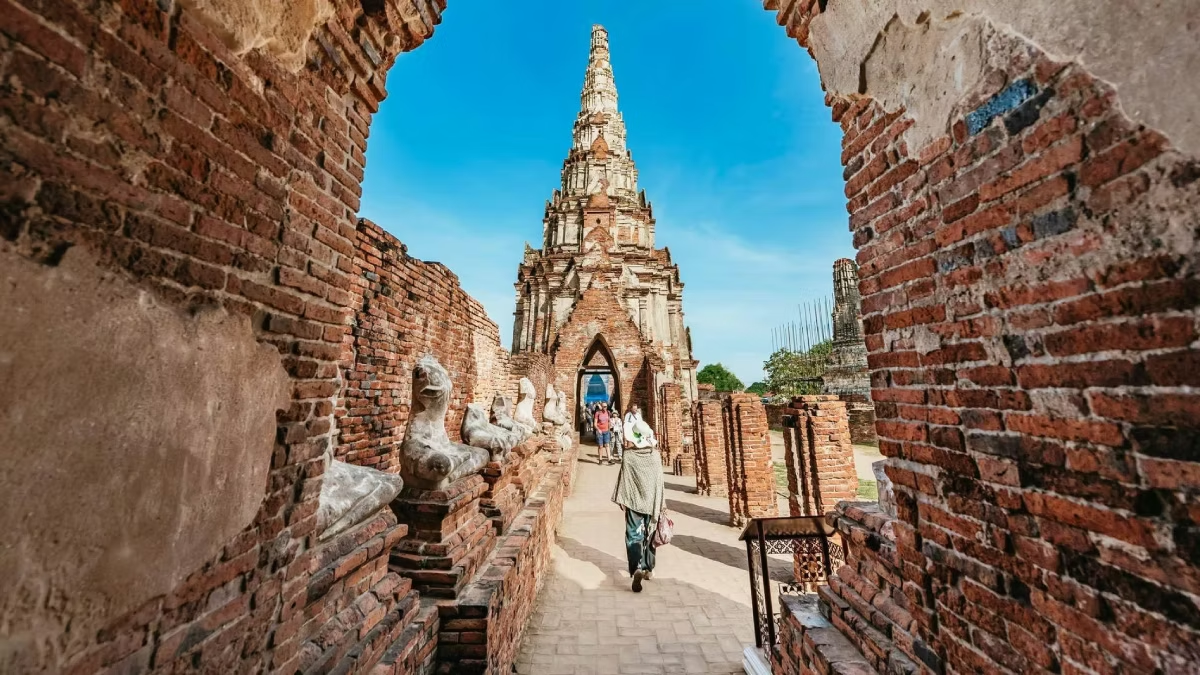
Ayutthaya Historical Park is a UNESCO World Heritage Site covering 289 hectares on the island city of Phra Nakhon Si Ayutthaya, 80 kilometres north of Bangkok. It contains the ruins of the capital of the Ayutthaya Kingdom (1351–1767), including 67 temple ruins, 4 active temples, and the foundations of 3 royal palaces. Entry to the park itself is free; individual temples charge 20–50 THB each, or 220 THB for a combo pass covering six major temples. It was declared a UNESCO World Heritage Site on 13 December 1991.
Few archaeological sites in Asia match Ayutthaya Historical Park for density of historical significance, accessibility from a major city, or the sheer scale of what was once here. In the mid-17th century, Ayutthaya was one of the largest cities in the world — a million inhabitants, global trade connections from China to Persia to Holland, and an architectural programme that produced hundreds of temples, palaces, and monasteries on an island the size of a small town. In 1767, the Burmese burned it all. What remains — the prangs, the chedis, the headless Buddhas, the ruined walls — is what Ayutthaya Historical Park preserves and presents.
What Is Ayutthaya Historical Park?
Ayutthaya Historical Park is a 289-hectare archaeological park on the island of Phra Nakhon Si Ayutthaya, Thailand, containing the ruins of the capital of the Ayutthaya Kingdom (founded 1351, destroyed 1767). It was declared a UNESCO World Heritage Site on 13 December 1991 under the name “Historic City of Ayutthaya.” The park is managed by Thailand’s Fine Arts Department (3rd Regional Office) and contains 67 restored temple ruins, 4 active temples, 3 royal palace sites, and multiple museum facilities. Individual temple entry costs 20–50 THB; a combo pass covering 6 temples costs 220 THB. The park area itself has no entry fee.
Ayutthaya Historical Park is not a single walled compound with a single entrance — it is an entire island city. The modern town of Phra Nakhon Si Ayutthaya coexists with the ruins on the same island, and the boundaries between the contemporary urban environment and the ancient archaeological sites are porous. You can cycle from a modern market to a 600-year-old temple complex within minutes.
The park covers 289 hectares on an island formed by three rivers: the Chao Phraya to the west and south, the Pa Sak to the east, and the Lopburi to the north. Additional important sites — including Wat Chaiwatthanaram, Wat Yai Chai Mongkhon, and Wat Phu Khao Thong — sit just outside the island boundaries but within the broader historical zone.
The Ayutthaya Kingdom: What the Park Commemorates
The Ayutthaya Kingdom was founded by King Ramathibodi I (U-Thong) in 1351 on an island at the confluence of three rivers that gave it natural defence and sea access simultaneously. The site was chosen precisely because the rivers positioned it above the tidal bore of the Gulf of Siam, protecting it from sea-going warships, while the river network provided trade routes to China, India, and eventually Europe.
Over 417 years and 33 kings, Ayutthaya grew into one of the largest and most cosmopolitan cities in the world. At its peak in the 17th century, it had a population of over one million — larger than London or Paris at the time. Its trading connections spanned Japan, China, Persia, India, and the European colonial powers. Foreign communities — Dutch, Portuguese, Japanese, Cambodian — lived in their own quarters on the island, and their settlements have left archaeological traces that form part of the site’s heritage value.
In 1767, after a two-year siege, Burmese forces under King Hsinbyushin captured the city. What followed was systematic: the palaces were looted, the temples were burned, the Buddha images were decapitated, and the city was abandoned. The records kept by the Siamese royal court — chronicles, lists, architectural drawings — were largely destroyed. Much of what historians know about Ayutthaya at its peak comes from the accounts of foreign visitors who wrote about what they saw.
The capital moved south to Bangkok in 1782. Ayutthaya was not rebuilt; it gradually became the archaeological site that tourists visit today.
What the Park Contains
Temple ruins (67 major restored sites): The majority of the park’s significance lies in its temples — prangs, chedis, viharans, and ordination halls in various states of preservation. The most important are on the central island: Wat Mahathat, Wat Ratchaburana, Wat Phra Si Sanphet, Wat Lokaya Sutha, and Wat Phra Ram. Off-island: Wat Chaiwatthanaram, Wat Yai Chai Mongkhon, Wat Phanan Choeng, and others.
Active temples (4): Wat Yai Chai Mongkhon, Wat Na Phra Mane, Wiharn Phra Mongkhon Bophit, and Wat Phanan Choeng have resident monks and active religious functions.
Royal palace foundations: The foundations of the Grand Palace (Wang Luang), Front Palace (Chantharakasem), and Rear Palace are preserved within the park. The palaces themselves were made primarily of wood and did not survive the 1767 fires; only the brick foundations remain.
Museums:
- Chao Sam Phraya National Museum — houses gold artefacts and sculptures recovered from temple crypts (including items from Wat Ratchaburana and Wat Mahathat). Open Wednesday–Sunday, 9:00 AM–4:00 PM. Entrance: 150 THB.
- Chantharakasem National Museum — housed in the former Front Palace, displays Ayutthaya-period artefacts. Open Wednesday–Sunday, 9:00 AM–4:00 PM. Entrance: 100 THB.
Foreign settlement sites: The archaeological remains of the Japanese village (Mura Yama community), the Dutch trading post, the Portuguese settlement, and St Joseph’s Church are located in the area south of the island — largely unrestored but historically significant.
Park Structure and Entry
No gate, no single entrance. The Historical Park has no perimeter fence or entry gate. You enter by road from any direction. Individual temple sites have their own ticket booths and charge their own fees.
Entry fees: Free for the park area itself. Individual temples charge 20 THB (active temples) or 50 THB (Fine Arts Department ruins). The 220 THB combo pass covers six major temples and is purchased at any of the six included entrances. See Ayutthaya Temple Entrance Fees.
Opening hours: Most temples open 8:00–8:30 AM. Closing times vary — Wat Ratchaburana and Wat Phra Si Sanphet close at 4:30 PM; Wat Mahathat at 6:00 PM; Wat Chaiwatthanaram at 6:30 PM. See Ayutthaya Temple Opening Hours.
The UNESCO Designation
The Historic City of Ayutthaya was inscribed on the UNESCO World Heritage List on 13 December 1991, under criterion (iii): “bear a unique or at least exceptional testimony to a cultural tradition or to a civilization which is living or which has disappeared.”
The inscribed area covers the central island zone — the core of the original city. Some important sites including Wat Chaiwatthanaram technically fall outside the inscribed boundary but within the broader management zone of the Fine Arts Department.
The UNESCO designation commits the Thai government to maintaining the site’s Outstanding Universal Value — a commitment that drives the ongoing restoration and conservation work of the Fine Arts Department’s 3rd Regional Office.
How to Plan Your Visit
One day: Covers the six major island temples plus Wat Chaiwatthanaram if you manage your time well. Start at 8:30 AM at Wat Mahathat. See our How Many Days Do You Need at Ayutthaya Temple guide for a full itinerary.
Two days: Adds the off-island temples (Wat Yai Chai Mongkhon, Wat Na Phra Mane, Wat Phu Khao Thong, Wat Phanan Choeng), a boat tour around the island, and the national museums.
Getting there: Train from Krung Thep Aphiwat Central Terminal (1–1.5 hours, from 15 THB) is the most atmospheric and practical option. See How to Get to Ayutthaya Temple from Bangkok.
Getting around: Bicycle (50–80 THB/day) is ideal for the central island. Tuk-tuk (200 THB/hr) for off-island temples. See Getting Around Ayutthaya Temple.
Book This TourFrequently Asked Questions
What is Ayutthaya Historical Park?
A 289-hectare UNESCO World Heritage Site on the island of Phra Nakhon Si Ayutthaya, Thailand, containing the ruins of the capital of the Ayutthaya Kingdom (1351–1767). It includes 67 temple ruins, 4 active temples, and multiple palace and museum sites.
When was Ayutthaya Historical Park designated a UNESCO World Heritage Site?
13 December 1991, under the name “Historic City of Ayutthaya” (UNESCO reference no. 576).
Is entry to Ayutthaya Historical Park free?
The park area has no entry fee. Individual temples charge 20–50 THB per person. A combo pass covering six major temples costs 220 THB.
Who manages Ayutthaya Historical Park?
Thailand’s Fine Arts Department, specifically its 3rd Regional Office based in Phra Nakhon Si Ayutthaya.
How many temples are in Ayutthaya Historical Park?
The park contains 67 restored temple ruins and 4 active temples within its boundaries. The broader historical city area contains additional sites outside the inscribed UNESCO zone.
