

Wat Phra Si Sanphet Ayutthaya: Complete Temple Guide (2026)
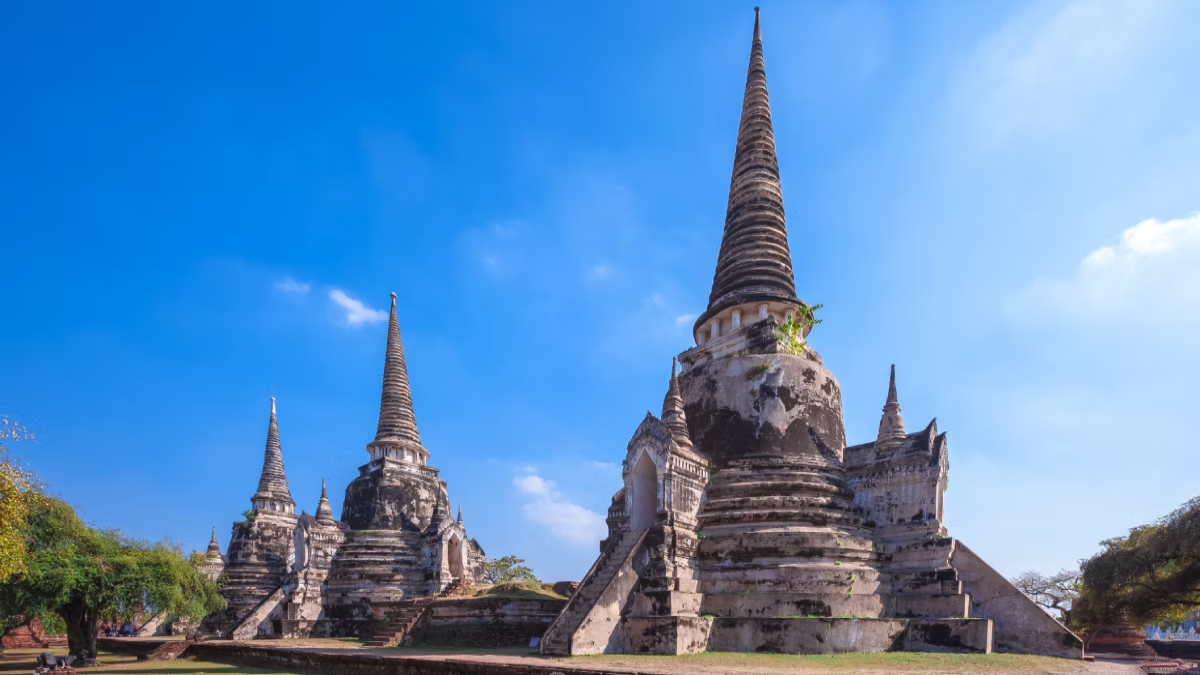
Wat Phra Si Sanphet is the most sacred temple of the Ayutthaya Kingdom — the royal chapel of the Grand Palace, used exclusively by the monarchy, where no monks ever lived and no ordinary worshippers ever entered. Its three iconic bell-shaped chedis (stupas), built to house the ashes of three Ayutthaya kings, are the defining image of the Historical Park and possibly the most recognised architectural symbol of ancient Thailand. Entrance costs 50 THB; it opens at 8:00 AM and closes at 4:30 PM.
Where Wat Mahathat was Ayutthaya’s spiritual centre — the seat of the Supreme Patriarch and the religious heart of the kingdom — Wat Phra Si Sanphet was its political centre: the exclusive royal chapel inside the Grand Palace compound, reserved entirely for the monarchy, where coronations were performed and royal ashes were enshrined in the three towering chedis that still define the Ayutthaya skyline.
Standing before those three stupas is one of the clearest moments available to any visitor in Ayutthaya. Nothing here is overgrown or ambiguous. The composition is deliberate — three identical forms in precise alignment, their proportions immaculate, their purpose legible even in ruin.
Quick Facts
Wat Phra Si Sanphet (Temple of the Holy, Splendid Omniscient) was the holiest temple of the Ayutthaya Kingdom, built within the Grand Palace grounds and used exclusively by the royal family. Its three bell-shaped chedis, constructed in 1492 and 1529, enshrine the ashes of Kings Borommatrailokkanat, Borommarachathirat III, and Ramathibodi II. The temple once housed a 16-metre standing golden Buddha weighing approximately 64 tonnes, destroyed by Burmese forces in 1767. Entrance costs 50 THB. It opens at 8:00 AM and closes at 4:30 PM.
| Detail | Information |
|---|---|
| Thai name | วัดพระศรีสรรเพชญ์ |
| Translation | Temple of the Holy, Splendid, Omniscient |
| Built | 1448 (converted from palace), chedis 1492 and 1529 |
| Location | Central island, Ayutthaya Historical Park (within former Grand Palace grounds) |
| Entrance fee | 50 THB (included in 220 THB combo pass) |
| Opening hours | 8:00 AM – 4:30 PM daily |
| Time to allow | 45–60 minutes |
| Best time to visit | 8:00–10:00 AM |
History
The site of Wat Phra Si Sanphet began as a royal palace — the original residence of King Ramathibodi I, who founded Ayutthaya in 1351. In 1448, King Borommatrailokkanat built a new palace further north and converted the old palace grounds into a holy site: a royal temple that would serve as the spiritual centre of the monarchy’s power, distinct from Wat Mahathat’s role as the religious centre of the Buddhist institution.
What distinguished Wat Phra Si Sanphet from every other temple in Ayutthaya was its exclusivity. No monks lived here. No lay devotees came for daily worship. It was the private temple of the king and royal family, used for the most significant state ceremonies — including the swearing of allegiance by royal officers, coronation rituals, and royal merit-making. Its closest equivalent today is Bangkok’s Wat Phra Kaew (Temple of the Emerald Buddha), which drew direct architectural inspiration from it.
The three chedis: In 1492, King Ramathibodi II ascended the throne. His first act was to cremate the remains of his father, King Borommatrailokkanat, and his brother, King Borommarachathirat III — and to build two great bell-shaped chedis to enshrine their ashes. A third chedi was added in 1529 by King Borommarachathirat III to enshrine Ramathibodi II’s own ashes. This completed the iconic trio.
The golden Buddha: At the peak of the temple’s glory, Wat Phra Si Sanphet housed Phra Si Sanphetdayan — a 16-metre standing bronze Buddha image covered in approximately 343 kilograms of pure gold leaf. The statue weighed around 64 tonnes and took over three years to complete. It was the kingdom’s most sacred object and gave the temple part of its name.
The 1767 destruction: When Burmese armies sacked Ayutthaya in 1767, they stripped the gold from the standing Buddha and melted it down. The viharan (assembly hall) was set on fire. Two of the three chedis were destroyed, though their foundations survived. Only the eastern chedi remained structurally standing. All three were substantially restored by the Fine Arts Department beginning in 1956, completing work that recovered their form while leaving visible the scars of what happened here.
Book This TourWhat to See at Wat Phra Si Sanphet
The three chedis: The heart of the site and Ayutthaya’s most reproduced architectural image. Standing on a raised rectangular brick platform aligned east-west, the three stupas are in the Sukhothai style with Ayutthayan modifications — each with four outward-projecting porches and a series of receding tiers leading to the bell-shaped crown. Each chedi originally contained a small inner chamber for the king’s ashes.
The royal palace foundations: Surrounding the chedis are the foundations of the Grand Palace complex — the outlines of viharans, cloisters, and subsidiary shrines that once made this the most elaborate religious compound in the kingdom. The scale of the foundations gives a sense of what the full complex looked like at its 17th-century peak.
Viharan Luang foundation: The site of the great assembly hall that once housed the golden Phra Si Sanphetdayan Buddha image. Only the floor plan and altar base remain, but the scale communicates the ambition of the original structure — 50 metres long, built to accommodate royal ceremonies attended by the entire court.
Prasat Phra Narai: The cross-shaped viharan added by King Narai in the mid-17th century on the western side of the chedis, reflecting the architectural innovations of Ayutthaya’s most cosmopolitan period, when European, Persian, and Indian influences entered the royal court.
Practical Visitor Information
Note the 4:30 PM closing time. Wat Phra Si Sanphet is one of two major temples in Ayutthaya that close at 4:30 PM — significantly earlier than Wat Mahathat (6:00 PM) and Wat Chaiwatthanaram (6:30 PM). Plan your visit for the morning or early afternoon; do not arrive expecting to enter after 4:00 PM.
Arrive at opening (8:00 AM). The morning light falls directly on the eastern face of the chedis, emphasising their surface texture and the depth of their tiers. By 10:00 AM, tour groups have arrived and the platform in front of the three chedis becomes crowded.
Wiharn Phra Mongkhon Bophit is directly adjacent. After visiting Wat Phra Si Sanphet, the active shrine housing one of Thailand’s largest bronze Buddha images is immediately adjacent — a 5-minute walk. The contrast between the silent archaeological site and the active place of devotion is striking and worth experiencing.
Minimal shade. The open brick platform has very limited shade. A hat, sunscreen, and water are essential in the hot season.
Buy the combo pass at Wat Mahathat. If you start your day at Wat Mahathat, buy the 220 THB combo pass there — it covers Wat Phra Si Sanphet and four other major temples.
Best Time to Visit
Morning (8:00–9:30 AM): Best light, fewest crowds. The eastern face of the chedis catches the morning sun most directly at this time.
Afternoon: Possible until 4:00 PM (to allow time before 4:30 PM closing), but the afternoon light falls on the western faces of the chedis rather than the iconic frontage, and the heat is significant.
Avoid late afternoons. Unlike Wat Chaiwatthanaram, Wat Phra Si Sanphet does not benefit from dusk light and closes too early for it in any case. This is a morning temple.
Getting to Wat Phra Si Sanphet
Located approximately 700 metres west of Wat Mahathat along the central island, within easy walking or cycling distance. The temple is well-signposted from the main Naresuan Road intersection. Wiharn Phra Mongkhon Bophit is immediately adjacent on the same grounds.
Frequently Asked Questions
What are the three chedis at Wat Phra Si Sanphet?
Three bell-shaped stupas built to enshrine the ashes of three Ayutthaya kings. Left to right (west to east): the western chedi holds King Ramathibodi II’s ashes (built 1529); the middle chedi holds King Borommarachathirat III’s ashes; and the eastern chedi holds King Borommatrailokkanat’s ashes (both built 1492).
Why were there no monks at Wat Phra Si Sanphet?
The temple was exclusively a royal chapel, used solely for state ceremonies and royal rituals. Its sacred character was defined by royal power rather than monastic life — closer to the Grand Palace chapel than to a functioning monastery.
What happened to the golden Buddha?
The 16-metre, 343-kilogram-gold-covered Phra Si Sanphetdayan Buddha was stripped of its gold by Burmese forces in 1767 and the gold was melted down. The bronze core was later salvaged and installed in a chedi at Bangkok’s Wat Pho, where it remains today.
Why does Wat Phra Si Sanphet close at 4:30 PM?
All Fine Arts Department temples follow the standard hours set by the park administration. Wat Phra Si Sanphet is among those that close at 4:30 PM rather than the later 6:00–6:30 PM available at some other sites. Plan your visit for the morning.
Is Wat Phra Si Sanphet or Wat Mahathat more important to visit?
Both are essential. Wat Mahathat is more emotionally immediate (the Buddha head in tree roots). Wat Phra Si Sanphet provides a clearer picture of Ayutthaya’s royal and political history. Visiting both — which takes 15 minutes to walk between them — is far preferable to choosing one.
