

Wat Chaiwatthanaram Ayutthaya: Complete Temple Guide (2026)
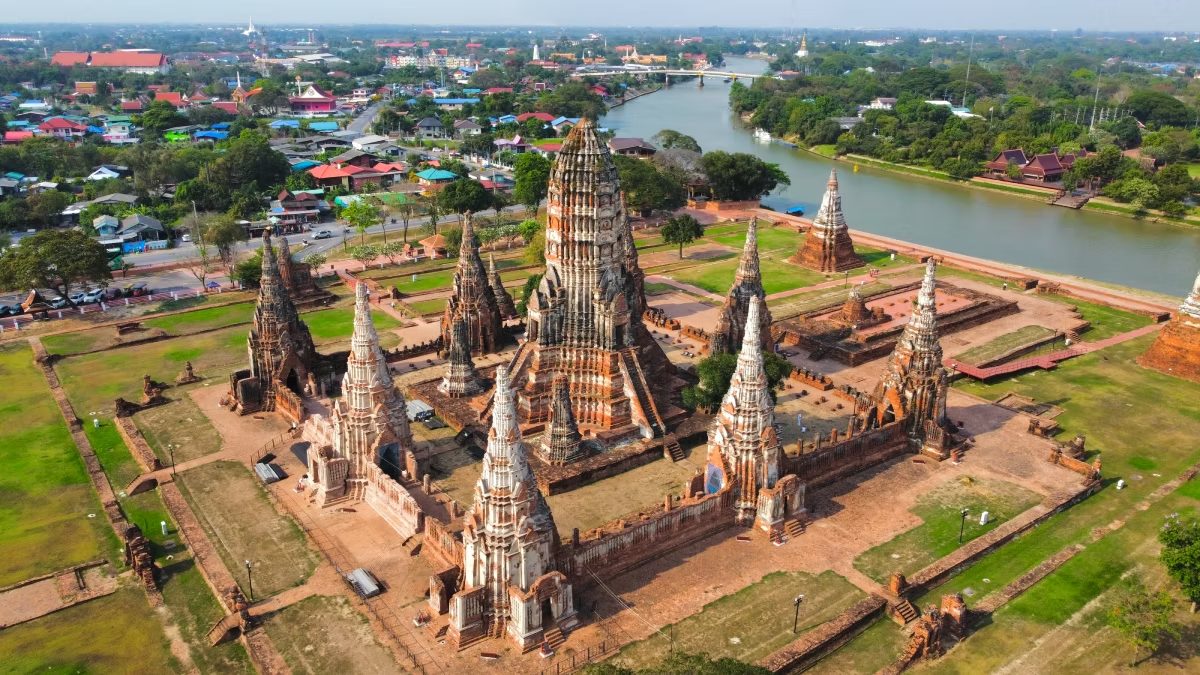
Wat Chaiwatthanaram is Ayutthaya’s most dramatically positioned and photographically compelling temple — a Khmer-style riverside complex built in 1630 by King Prasat Thong, with a 35-metre central prang surrounded by smaller towers in a symmetrical layout symbolising Mount Meru and Buddhist cosmology. Located on the west bank of the Chao Phraya River outside the central island, it is the best temple in Ayutthaya for late afternoon and sunset photography. Entrance costs 50 THB; it opens at 8:00 AM and closes at 6:30 PM.
Ayutthaya has more dramatic ruins, more layered history, and more emotionally resonant sites than most visitors expect. But for sheer visual impact — the kind of temple that stops you before you’ve even read the sign — Wat Chaiwatthanaram is hard to match. Its composition is theatrical in the best sense: a towering central prang rising above a symmetrical arrangement of smaller towers and galleries, set against the Chao Phraya River on one side and the Ayutthaya sky on the other. In the late afternoon, when the sun descends toward the river and the brick turns gold, it becomes one of the most atmospheric places in Thailand.
Quick Facts
Wat Chaiwatthanaram (Temple of Long Reign and Glorious Era) was built in 1630 by King Prasat Thong on the west bank of the Chao Phraya River. Designed in Khmer architectural style, its 35-metre central prang represents Mount Meru — the cosmic mountain at the centre of Buddhist and Hindu cosmology — surrounded by four smaller prangs and eight chedis in a rectangular gallery. The temple was destroyed in the Burmese invasion of 1767 and restored by the Fine Arts Department beginning in 1987. Entrance costs 50 THB. Opening hours are 8:00 AM to 6:30 PM.
| Detail | Information |
|---|---|
| Thai name | วัดไชยวัฒนาราม |
| Translation | Temple of Long Reign and Glorious Era |
| Built | 1630, reign of King Prasat Thong |
| Location | West bank of Chao Phraya River (off-island) |
| Entrance fee | 50 THB (included in 220 THB combo pass) |
| Opening hours | 8:00 AM – 6:30 PM daily |
| Time to allow | 45–90 minutes |
| Best time to visit | 3:30–6:00 PM (afternoon and dusk) |
History
Wat Chaiwatthanaram was built in 1630 as the first major royal commission of King Prasat Thong, one of the most powerful rulers of 17th-century Ayutthaya. The temple was dedicated as a memorial to his mother — her ashes were enshrined in two chedis flanking the main ubosot (ordination hall) on the eastern side of the complex — and as a powerful statement of royal Buddhist merit. The name itself, translating as Temple of Long Reign and Glorious Era, was less a description than an aspiration and a declaration of royal legitimacy.
The choice of Khmer architectural style was deliberate and politically significant. By modelling his temple on the great Angkorian tradition, Prasat Thong situated himself in a lineage of sacred kingship that stretched back to the height of Khmer power in mainland Southeast Asia. This was not imitation for its own sake but a calculated act of dynastic legitimisation — evoking the grandeur of an older tradition to amplify the authority of the present one.
The temple served as a royal chapel throughout the Ayutthaya period. Kings and senior members of the royal family performed religious ceremonies here. Princes and princesses were cremated within its grounds. Canon balls found during excavations suggest the temple was used as a defensive position during the wars with Burma.
In 1767, Burmese forces sacked Ayutthaya and left the temple in ruins. It lay abandoned for over two centuries. Major restoration work began in 1987, funded by a 200 million THB government budget — significant enough to suggest the temple’s importance to Thailand’s cultural heritage. The complex as visitors see it today reflects those restorations, which recovered the temple’s symmetry while leaving visible the signs of age and damage.
Book This TourArchitecture: Understanding What You’re Looking At
Wat Chaiwatthanaram is a mandala — a sacred diagram of the Buddhist universe rendered in brick and stone.
The central prang: The 35-metre Khmer-style central tower represents Mount Meru, the cosmic mountain at the centre of Buddhist and Hindu cosmology, the axis of the universe around which all worlds revolve. Its form — a tapering corncob shape rising from a receding series of terraced bases — is the defining Khmer architectural expression of this cosmological concept.
The four corner prangs: Four smaller prangs at the cardinal points of the main platform represent the four continents of the Buddhist cosmological world surrounding Mount Meru.
The eight chedis: Eight bell-shaped stupas arranged in a rectangular gallery around the platform represent further elements of the cosmological map. Together with the central and corner prangs, they create a three-dimensional diagram of the universe that was meant to be walked around, its meaning understood by the ritually initiated.
The ubosot and river axis: The main entrance faces east, toward the Chao Phraya River. The king would arrive by royal barge and enter the compound through the east gate — the river was not a backdrop but an integral part of the ceremonial approach. Even today, the temple reads best from the water.
The Khmer-Angkor comparison: Many descriptions compare Wat Chaiwatthanaram to Angkor Wat. The comparison is useful as a shorthand but misleading in scale — Angkor Wat is vastly larger. What they share is the architectural vocabulary: the mountain-temple concept, the concentric enclosures, the gallery of figures, the axial alignment with water. Wat Chaiwatthanaram is a mature expression of this tradition within Ayutthayan idiom, not a copy.
What to See at Wat Chaiwatthanaram
The central prang: Walk the full circuit around the base. The four staircases at the cardinal points each offer a different angle on the central tower, and the relationship between the central prang and the surrounding smaller structures changes as you move around it.
The gallery chedis: The eight chedis in the surrounding rectangular gallery originally displayed scenes from the life of the Buddha in bas-relief carving. Much of the original stucco has been lost, but fragments of carved relief survive and give a sense of the visual programme that once covered the complex.
The ubosot foundation: The ordination hall on the east side of the compound, flanked by the two chedis containing the ashes of King Prasat Thong’s mother. The altar base and some structural elements survive.
The river view: From the east side of the complex, looking back toward the central prang with the Chao Phraya behind you, you get the most theatrical compositional angle in all of Ayutthaya. This is the photograph most visitors come for.
Sunset: Wat Chaiwatthanaram faces west. The setting sun illuminates the central prang and western faces of the chedis in gold-red light that transforms the already striking ruins into something genuinely breathtaking. Plan to be here in the 4:00–6:00 PM window if weather permits.
Practical Visitor Information
This temple is off the central island. Wat Chaiwatthanaram sits on the west bank of the Chao Phraya River, outside the central island. From Wat Mahathat, it is approximately 2.5 kilometres by road. Take a tuk-tuk (80–100 THB), cycle along the riverside path (15 minutes), or take a river taxi.
Latest closing time in the park (6:30 PM). This is one of the few advantages of visiting in the afternoon — the 6:30 PM closing gives you the most time of any major temple for a dusk visit. Security guards will start rounding up visitors around 6:15 PM.
No shoes inside buildings. Remove footwear before entering any intact chapel or building with a Buddha image.
Allow 45–90 minutes. The grounds are extensive. A circuit of the full complex takes 20–30 minutes; allow extra time if photographing at dusk when the light changes rapidly.
Thai traditional costume rental. Near the temple entrance, vendors offer traditional Thai costume rental for photography — popular among Thai domestic tourists and increasingly common. If you plan to photograph in costume, arrange this before entering the main grounds.
Best Time to Visit
Late afternoon (3:30–6:00 PM): Unambiguously the best time. The temple faces west and the entire western face of the complex is illuminated in golden-hour light. This is when the composition becomes something beyond an interesting ruin — it becomes theatrical, beautiful, and worth the trip from Bangkok in itself.
Early morning (8:00–9:30 AM): A good alternative. The eastern face is lit by morning sun, the crowds are thin, and the cool temperatures make the walk around the complex comfortable. The composition is less dramatic than the late afternoon but the atmosphere is serene.
Avoid 10:00 AM–3:00 PM. The overhead midday light is flat and harsh, the heat intense, and the most popular spot near sunset draws the day’s maximum crowd.
Book the Sunset Boat CruiseGetting to Wat Chaiwatthanaram
By tuk-tuk: The most convenient option from anywhere in central Ayutthaya. Approximately 10–15 minutes and 80–100 THB one way. Ask for return pick-up if you don’t want to wait for another.
By bicycle: A 15-minute ride from the central island along the riverside road. The route is scenic and mostly flat. Use the western road along the Chao Phraya bank rather than the busier internal island roads.
By river taxi: Some operators run small boats between the island and Wat Chaiwatthanaram. This provides the most atmospheric arrival — you approach as kings once did, from the river.
Frequently Asked Questions
Why is Wat Chaiwatthanaram the best temple for sunset?
It faces west and sits on the riverbank. The setting sun illuminates the central prang and western façades directly, and the Chao Phraya River reflects the light to the east. The combination of Khmer architecture, river setting, and golden-hour light is without equal in Ayutthaya.
Is Wat Chaiwatthanaram part of Ayutthaya Historical Park?
It is managed as part of the Historical Park and included in the 220 THB combo pass, but technically sits outside the UNESCO World Heritage Site boundary — the inscribed zone covers the central island. Its inclusion in the Fine Arts Department’s portfolio means it receives the same restoration and conservation attention.
How was the temple damaged in 2011?
The 2011 Thai floods submerged Wat Chaiwatthanaram under approximately two metres of water, causing significant structural damage. Subsequent restoration work under a 200 million THB budget repaired much of the damage.
Can I climb the central prang?
No. Climbing the structures is not permitted to protect the ancient brick from further erosion.
Is this the same as Angkor Wat?
No. Angkor Wat is a much larger complex in Cambodia. Wat Chaiwatthanaram uses the same Khmer architectural vocabulary — the mountain-temple concept, axial layout, concentric enclosures — but is distinctly Ayutthayan in its expression and significantly smaller in scale.
