

Wat Lokaya Sutha Ayutthaya: Complete Temple Guide (2026)
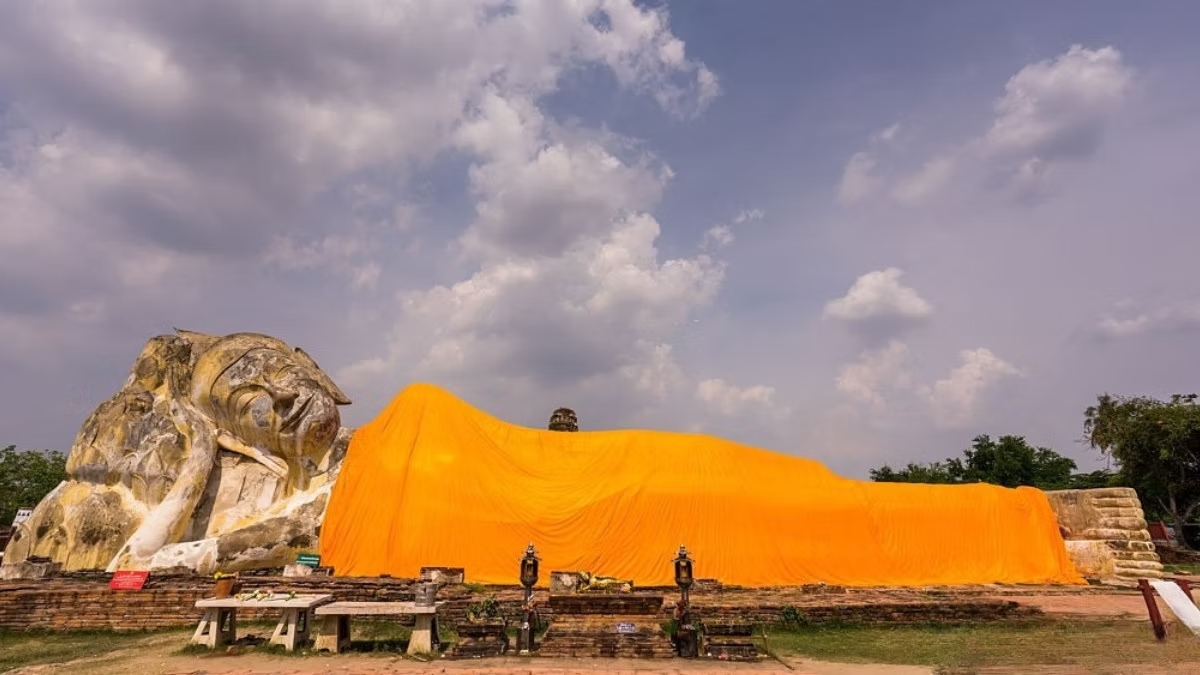
Wat Lokaya Sutha (Temple of the Earth) is home to Ayutthaya’s most striking reclining Buddha — a 42-metre-long, 8-metre-high brick and plaster image lying in the open air, draped in an orange cloth, facing west toward the setting sun. Admission is free; there are no formal opening times. The site requires no entrance fee, no ticket booth, and no combination pass — you simply arrive, look up, and find yourself before one of the largest reclining Buddhas in Thailand.
There are moments in Ayutthaya when the scale of what was built here truly lands. Wat Lokaya Sutha provides one of them. The reclining Buddha arrives without warning as you turn into the grounds — 42 metres of serene, orange-draped stone simply present in the open air, surrounded by the ruins of the viharan that once sheltered it. No roof, no walls, just the Buddha and the sky.
Quick Facts
Wat Lokaya Sutha is a temple ruin on the central island of Ayutthaya Historical Park, famous for its 42-metre-long, 8-metre-high open-air reclining Buddha image known as Phra Buddha Sai Yat. The temple dates to the early or middle Ayutthaya period (estimated 14th–16th century); the exact founding date is unknown. Admission is free. The site is open-air with no formal closing time, though the main grounds are accessible from early morning. The reclining Buddha faces west and was restored by the Fine Arts Department in 1956.
| Detail | Information |
|---|---|
| Thai name | วัดโลกยสุธา |
| Translation | Temple of the Earth / Temple of the World |
| Founded | Estimated 14th–16th century (exact date unknown) |
| Location | Central island, western section (near former Grand Palace) |
| Entrance fee | Free |
| Opening hours | No formal closing time (open-air site) |
| Time to allow | 15–25 minutes |
| Best time to visit | Early morning or late afternoon |
History
The exact founding date of Wat Lokaya Sutha is uncertain — a common situation in Ayutthaya, where the 1767 Burmese invasion and subsequent centuries of abandonment destroyed many of the written records that would have documented temple origins. What can be determined from the architectural style of the main prang is that the temple dates from the early to middle Ayutthaya period — the same style as Wat Mahathat and Wat Ratchaburana, suggesting a 14th or 15th-century founding.
The temple’s location, just 350 metres from the former Grand Palace and directly west of Wat Phra Si Sanphet, suggests it was an important site — royally proximate temples rarely existed by accident. It may have served as the primary temple for the western section of the royal compound.
The Burmese invasion of 1767 destroyed whatever monastic buildings surrounded the reclining Buddha. The viharan (assembly hall) that once sheltered the statue has long since collapsed, leaving the brick and plaster image exposed entirely to the elements. The Fine Arts Department undertook major restoration work on the reclining Buddha in 1956, and subsequent maintenance has kept it in presentable condition.
Book This TourThe Reclining Buddha: What You’re Looking At
The reclining Buddha at Wat Lokaya Sutha — known in Thai as Phra Buddha Sai Yat — is 42 metres in length and 8 metres in height. It faces west, with the head to the north resting on a lotus flower, and the feet at the southern end with legs and feet squarely overlapping in the classic reclining posture.
The iconography: The reclining pose (Sai Yat) depicts the Buddha at the moment of his final passing into parinirvana (final Nirvana). The Buddha lies on his right side, his right arm supporting his head on a pillow of lotus flowers. The pose does not depict illness or sleep — it depicts the moment of enlightened death, the state of complete liberation from suffering. The calm, serene expression on the face reflects the Ayutthaya artistic tradition of the middle period (1488–1629 CE): a long face, the arm supporting the head held vertically rather than folded (a distinctive middle-period characteristic).
West-facing orientation: In Buddhist cosmology, west represents the direction of the setting sun — associated with death, completion, and the passing from one realm to another. A reclining Buddha facing west is positioned to represent this passage more fully.
The orange cloth: The statue is typically draped in an orange cloth (the colour of Buddhist monkhood), which serves both as a devotional offering and as a visual framing device that gives the image its characteristic appearance. Offerings of lotus flowers and incense are made at the small altar in front of the statue, where a miniature reclining Buddha in the same pose is covered in tiny squares of gold leaf placed by devotees.
What to See at Wat Lokaya Sutha
The reclining Buddha: The dominant feature and the reason everyone comes. Walk the full length from head to feet — 42 metres takes a meaningful amount of time to traverse — and take in the scale from different angles. The head is best photographed from slightly to the side and below to capture the expression and the lotus pillow.
The central prang: Adjacent to the reclining Buddha stands the temple’s main prang in reasonably good condition, with a few surviving stucco ornaments on its upper sections. It is smaller than the great prangs of Wat Mahathat or Wat Ratchaburana but provides context for the temple’s original layout.
The Lanna-style chedi: In the northwest corner stands a smaller chedi with distinctive Lanna (northern Thai) architectural characteristics — a square base with receding tiers supporting an almost prang-like form. This is an unusual style for an Ayutthaya-period temple and suggests this structure was added at a different period from the main buildings.
The surrounding ruins: The brick foundations of viharans and cloisters are visible across the grounds, giving a sense of the temple’s original footprint — roughly 130 metres across, with the classic Ayutthaya layout of a central prang surrounded by a courtyard and gallery.
Practical Visitor Information
Free admission and no formal closing time. This is the simplest temple visit in Ayutthaya — walk in, look around, leave. No ticket booth, no combo pass required, no need to check the clock. The grounds are accessible from early morning.
15–25 minutes is sufficient. Wat Lokaya Sutha is a single-image site — the reclining Buddha is the reason to come, and once you have circled it and explored the surrounding ruins, you have seen what there is to see. It makes an excellent stop between other nearby temples rather than a standalone destination.
Dress code still applies. Despite the free admission and open-air nature, the temple is still a place of active Buddhist devotion — covered shoulders and knees are expected as at all Ayutthaya sites.
No shade on the Buddha. The statue is fully exposed to the elements. Visit in the early morning or late afternoon to avoid direct overhead sun and to benefit from better photography light.
Best Time to Visit
Early morning: The low morning sun illuminates the Buddha’s face and body from the east, creating directional light and stronger shadows than the flat overhead conditions of midday.
Late afternoon: The west-facing head of the Buddha catches the warm afternoon light — fitting for an image facing the direction of the setting sun. This is the most photogenic window.
Frequently Asked Questions
What is the reclining Buddha at Wat Lokaya Sutha?
A 42-metre-long, 8-metre-high brick and plaster reclining Buddha image (Phra Buddha Sai Yat) lying in the open air — the largest reclining Buddha on Ayutthaya island. It depicts the Buddha at the moment of his passing into final Nirvana.
Is Wat Lokaya Sutha free?
Yes. There is no entrance fee and no formal ticket booth. It is one of the few major temple sites in Ayutthaya Historical Park that is entirely free to visit.
Why is the reclining Buddha orange?
The statue is draped in orange cloth — the colour of Buddhist monkhood — as an act of devotion by local Buddhists. The same offering of saffron or orange cloth is made to Buddha images at active temples throughout Thailand.
How long is the reclining Buddha at Wat Lokaya Sutha?
42 metres in length and 8 metres in height.
