

Ayutthaya Temple History: The Rise, Fall & Legacy of a Kingdom (2026)
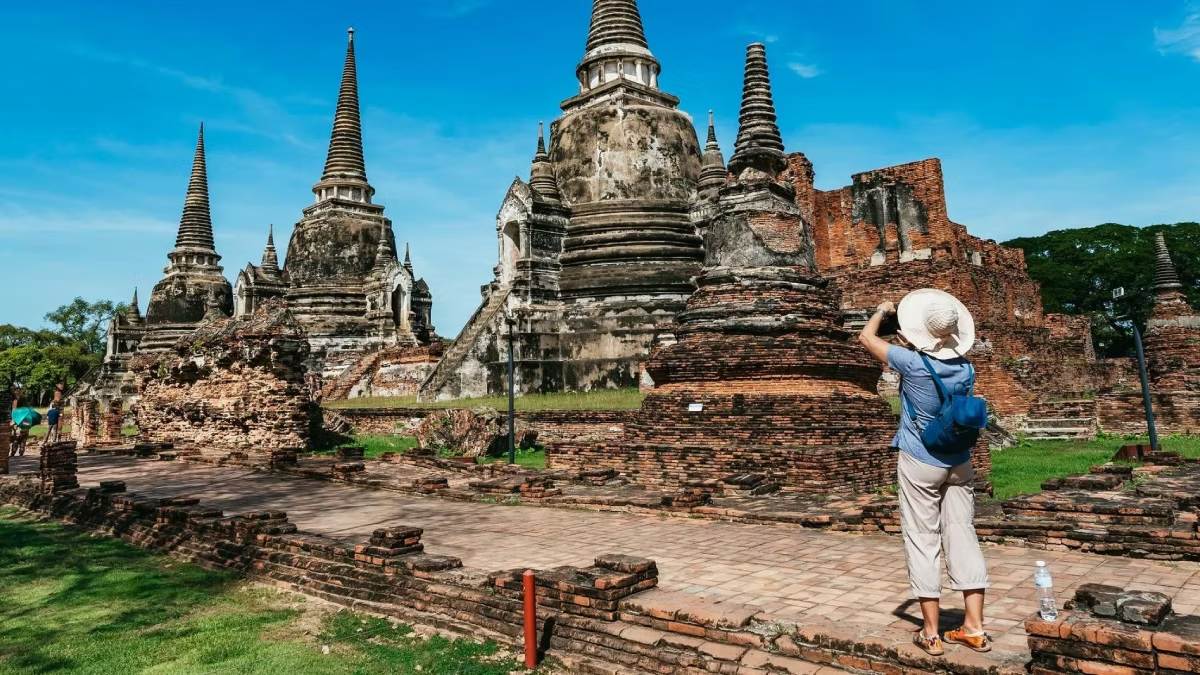
The temples of Ayutthaya Historical Park are the surviving remnants of a Southeast Asian kingdom that lasted 417 years (1351–1767) under 33 kings and became one of the largest and most cosmopolitan cities in the 17th-century world. They were built to serve a Buddhist monarchy whose rulers understood architecture as an expression of divine authority, accumulated merit, and political legitimacy. In 1767, the Burmese burned the capital and systematically destroyed its sacred monuments. What visitors see today — prangs, chedis, headless Buddhas — are the physical record of that destruction as much as of the original creation.
Understanding the history behind Ayutthaya’s temples does not just add interest to a visit — it changes what you see. The rows of truncated Buddha statues at Wat Mahathat are not random erosion; they are the deliberate work of a Burmese army in 1767. The three chedis at Wat Phra Si Sanphet are not decorative — they are the funerary monuments of specific kings. The hybrid architecture of Wat Phu Khao Thong embeds an entire political narrative in brick and stone. This guide provides the historical framework that makes these sites legible.
The Founding of Ayutthaya (1351)
The Ayutthaya Kingdom was founded in 1351 by King Ramathibodi I (U-Thong) on an island formed by the confluence of the Chao Phraya, Pa Sak, and Lopburi rivers, 80 kilometres north of the Gulf of Siam. The location was chosen for strategic reasons: the rivers provided natural defence, sea trade access, and protection from tidal flooding. Ayutthaya became the second Siamese capital after Sukhothai and grew over 417 years under 33 kings to become one of the largest cities in the world by the 17th century.
The site was not uninhabited before 1351. Archaeological evidence shows occupation during the Mon Dvaravati period (6th–11th centuries), and Khmer sources indicate a settlement called Ayodhya was established around the 9th century. King Ramathibodi I selected the island strategically: three rivers meant natural moats on all sides, sea connections meant trade, and elevation above the tidal bore meant security from coastal attack.
The kingdom he founded initially absorbed the existing political structures of the region, including competing principalities and the remnants of Khmer influence. Early Ayutthayan architecture reflects this absorption: the first major temples drew on Khmer architectural vocabulary (the prang, the gallery layout, the mountain-temple concept) while incorporating Theravada Buddhist iconography and the emerging distinctly Thai artistic tradition.
Temple Building as Political Act
In the Ayutthaya Kingdom, building a temple was never purely a religious act. Every major temple commission was simultaneously an assertion of royal legitimacy, an accumulation of Buddhist merit, a political monument, and an economic statement.
Merit and monarchy: Theravada Buddhism holds that accumulated merit — virtue generated through pious acts — translates across rebirths. A king who commissioned great temples was publicly accumulating merit at a scale only a king could achieve, demonstrating both his piety and the cosmic appropriateness of his rule. The greater the temple, the greater the merit; the greater the merit, the more legitimate the monarch.
Specific dedications: The three chedis of Wat Phra Si Sanphet were built by a specific king (Ramathibodi II) for specific people (his father and brother). Wat Ratchaburana was built by a specific king (Borommarachathirat II) to commemorate the brothers who died for his throne. Wat Chaiwatthanaram was built by a specific king (Prasat Thong) for his mother. These are not generic monuments — they are personal and dynastic statements in architectural form.
Architectural competition: As the kingdom grew, successive kings built on and around their predecessors’ work. Temples were expanded, chedis were added, and the overall effect was an increasingly dense sacred landscape in which every major ruler had left a mark. The Historical Park reflects four centuries of this accumulation.
Key Periods of Temple Construction
Early Ayutthaya (1351–1488): The foundational period. Wat Mahathat (c. 1374) establishes the spiritual centre of the kingdom. Wat Ratchaburana (1424) provides the first major example of early Ayutthayan Khmer-influenced prang architecture. Wat Phra Si Sanphet begins its evolution into the kingdom’s holiest site. Architecture in this period shows strong Khmer influence adapted to Theravada Buddhist purposes.
Middle Ayutthaya (1488–1629): The golden age of temple construction. King Ramathibodi II (1491–1529) builds the three chedis at Wat Phra Si Sanphet and commissions the legendary 16-metre golden Buddha. Wat Yai Chai Mongkhon receives its great victory chedi after King Naresuan’s 1592 elephant duel. Architecture becomes more distinctly Thai, integrating Sri Lankan bell-shaped chedis alongside Khmer prangs.
Late Ayutthaya (1629–1767): The final century. King Prasat Thong (1629–1656) builds Wat Chaiwatthanaram in conscious Khmer style — a political and aesthetic statement. King Narai (1656–1688) rules during Ayutthaya’s most cosmopolitan period, when Dutch, French, and Persian influences enter the court. King Borommakot (1733–1758) oversees the last major construction period before the final Burmese assault.
The Architectural Vocabulary of Ayutthaya’s Temples
Understanding a few key terms helps decode what you see at the Historical Park:
Prang: A Khmer-derived tower form — tall, tapering, with a corncob-shaped profile. Associated with Khmer sacred mountain symbolism, the prang represents Mount Meru, the axis of the Buddhist-Hindu cosmos. The great prangs at Wat Mahathat and Wat Ratchaburana are the finest surviving examples.
Chedi: A Thai-derived bell-shaped stupa form, adapted from Sri Lankan models. Used as a reliquary (housing sacred relics or royal ashes) and as a merit-making monument. The three chedis at Wat Phra Si Sanphet are the most famous examples.
Viharan: An assembly hall for Buddhist ceremonies, attached to most major temple complexes. Usually destroyed in 1767 or subsequently — only Wat Na Phra Mane retains an intact example.
Ubosot: An ordination hall, used for monastic initiation ceremonies. Marked by boundary stones (sema) and typically the most sacred building in a monastic complex.
The 1767 Destruction
On the 7th April 1767, after a two-year siege, Burmese forces under King Hsinbyushin entered the city of Ayutthaya. What followed was methodical. The palaces were looted. The temples were burned. The Buddha images were systematically decapitated — this was not incidental vandalism but deliberate desecration, intended to strip the sacred power from the city’s religious monuments. Tens of thousands of Siamese were captured and taken to Burma.
The royal records of the Ayutthayan court — chronicles, lists, architectural drawings, literary works — were largely destroyed in the fires. Much of what historians know about Ayutthaya before 1767 comes from the records of foreign visitors: Dutch, French, English, Chinese, Japanese, and Persian travellers who documented what they saw in the city at its height.
The city was abandoned. The Siamese capital moved south to Thonburi and then to Bangkok. Ayutthaya was not rebuilt; it became the ruined field of archaeologically significant brick and stone that visitors see today.
Book This TourRediscovery and Conservation
The ruins of Ayutthaya attracted royal attention during the 19th century reign of King Chulalongkorn (Rama V), who began initial surveys and minor conservation work. Formal archaeological excavation and restoration began in 1969 under the Fine Arts Department. The site was declared a historical park in 1976 and a UNESCO World Heritage Site in 1991.
Conservation work continues today. The Fine Arts Department’s 3rd Regional Office maintains the active restoration programme, working to stabilise structures, reconstruct lost elements where evidence permits, and protect the surviving murals (most notably in the crypt of Wat Ratchaburana) from further deterioration.
What the Temples Tell Us Now
Walking through Ayutthaya Historical Park today is simultaneously an encounter with what Ayutthaya was and what happened to it. The truncated Buddha statues are the evidence of the 1767 destruction — not accident, not erosion, but intention. The hybrid chedi at Wat Phu Khao Thong, with its Burmese base and Thai spire, encodes the territorial politics of two kingdoms in stone. The single intact ordination hall at Wat Na Phra Mane, preserved precisely because the Burmese used it as their headquarters, is the most eloquent comment on the fate of everything around it.
The temples that survive are not merely ruins. They are documents.
Frequently Asked Questions
When was the Ayutthaya Kingdom founded?
1351 by King Ramathibodi I (U-Thong), who established the second Siamese capital on an island formed by three rivers.
How many kings did Ayutthaya have?
33 kings over 417 years (1351–1767).
Why did the Burmese destroy Ayutthaya?
The Burmese-Siamese Wars were a recurring conflict spanning several centuries. The 1767 destruction was the culmination of a two-year siege and represented the end of a political rivalry as much as a military conquest. The systematic decapitation of Buddha images was a deliberate act of sacred desecration intended to break the city’s spiritual power.
What was Ayutthaya like at its height?
At its peak in the 17th century, Ayutthaya had a population of over one million — comparable to or larger than London, Paris, or Amsterdam at the time. It was a major international trading port with foreign communities including Dutch, Portuguese, Japanese, Chinese, Persian, and French. Its architecture was among the most ambitious in Southeast Asia.
